What Are Special Hazards?
Special hazards are environments that present unusual fire risks due to the nature of stored materials, the processes performed, or the extreme sensitivity of the content. They include:
- Server rooms and data centres
- Electrical control rooms and transformer rooms
- Commercial kitchens (restaurants, hotels, hospitals)
- Chemical storage and flammable liquid warehouses
- Petrol and gas stations
- Power generation rooms and electrical switchgear rooms
- Archives, museums and rare document repositories
- Industrial spray painting and coating rooms
Clean Agent Systems
Clean agent systems are the preferred choice for protecting electronic equipment, data and archives — they suppress fire without leaving any residue or moisture that could damage sensitive equipment.
FM-200 (HFC-227ea)
- Design Concentration: 7.0–8.0% by volume for Class A, B and C fires
- Discharge Time: Design concentration must be reached within 10 seconds
- Hold Time: Minimum 10 minutes
- Pre-discharge Warning: Minimum 30 seconds before discharge (required by ADCDA)
- Advantages: Non-toxic at design concentrations, no equipment damage, fast response
- Environmental: GWP = 3,220 (higher than Novec)
Novec 1230 (FK-5-1-12)
- Design Concentration: 4.2–5.9% by volume
- Discharge Time: ≤ 10 seconds
- Environmental: GWP = 1 — the most environmentally friendly industrial suppression agent available
- Equipment Impact: Zero — evaporates completely without residue
- Ideal for: Data centres, server rooms, museums, archives
Inergen (IG-541)
- Composition: 52% nitrogen + 40% argon + 8% CO₂
- Design Concentration: 43.1–52.5% by volume (reduces oxygen to 12.5%)
- Advantages: Natural gases, zero GWP, completely environmentally safe
- Cylinder Footprint: Larger than FM-200 — requires more storage space
- Ideal for: Large sites where fluorinated gases are restricted
CO₂ — Industrial Applications Only
- Critical Warning: The concentration required for suppression (34–75%) is lethal to humans — never used in spaces that may be occupied
- Permitted Use Only: Completely unoccupied spaces (generators, dip-coating tanks, industrial furnaces)
- UAE Code Requirement: An electrical interlock that prevents discharge when the access door is open is mandatory
Enclosure Integrity Requirements
A critical prerequisite for clean agent system success — any leakage allows the agent to escape before the fire is extinguished:
- Door Fan Test (Integrity Test): Mandatory at commissioning and periodically thereafter — measures room leakage rate
- Required Hold Time: The room must retain design concentration for a minimum of 10 minutes
- Vent Closure: All ventilation openings and ductwork close automatically at the moment of discharge
- Pressure Relief Vent: Mandatory to prevent structural damage from the pressure wave during discharge
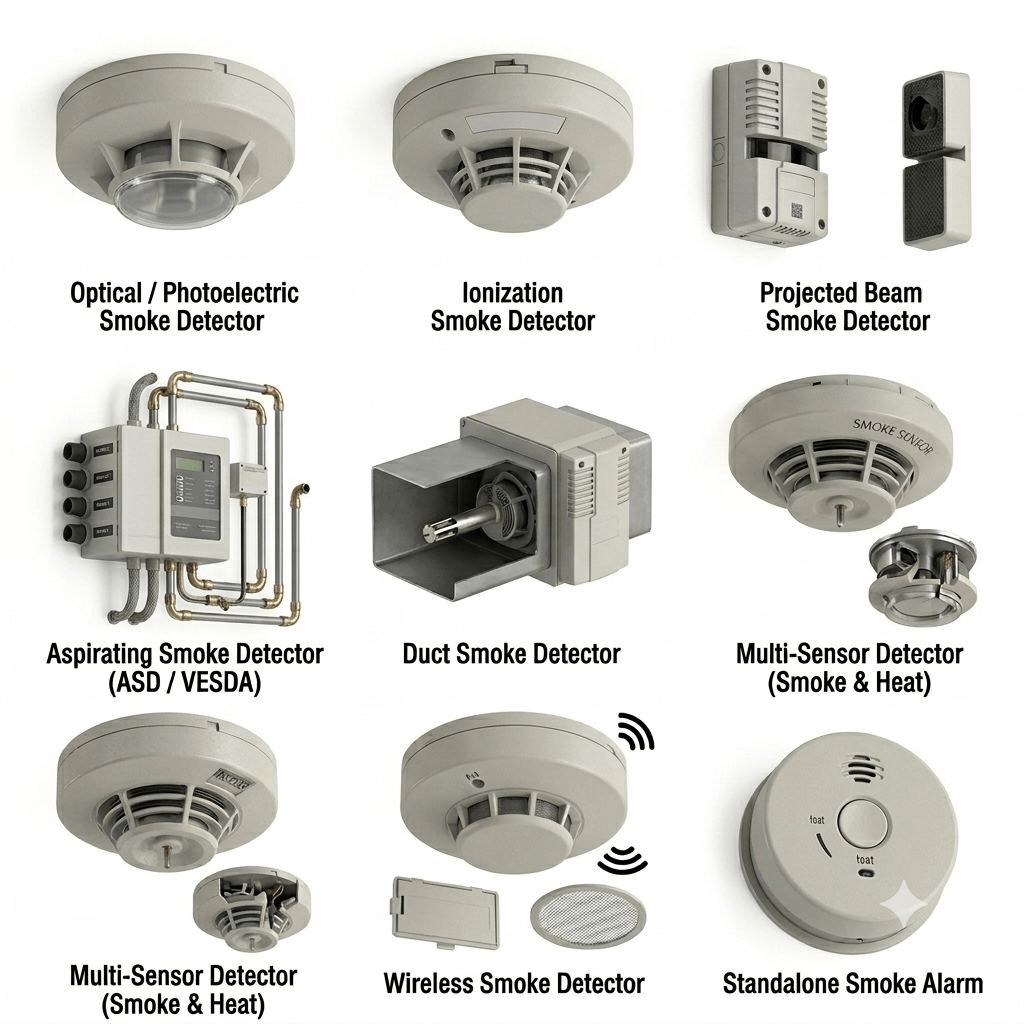
Aspirating Smoke Detection (VESDA) — Early Warning for Server Rooms
For server rooms and data centres, aspirating smoke detection (ASD) is strongly recommended as the first detection stage before system discharge:
- Operating Principle: Actively draws air samples through a network of perforated pipes, analysing them in a laser chamber
- Sensitivity: 1,000–10,000× more sensitive than conventional detectors — detects smoke before it becomes visible
- Alarm Levels: Action → Alert → Fire 1 → Fire 2 (escalating levels allowing staged intervention)
- Installation: One sampling hole per 1–4 m² of protected area
- Raised Floor: Mandatory coverage of the raised floor void in data centres
Commercial Kitchen Suppression Systems
Fat and oil fires (Class K) are among the most aggressive and fastest-spreading fire types — the UAE Code references NFPA 17A and UL 300:
- Required System Type: Wet chemical system, UL 300 listed
- Activation: Automatic on fire detection + manual (pull station)
- Fuel Shutoff: Mandatory — gas or electricity to cooking equipment must be cut automatically on discharge
- Manual Pull Station: No more than 3 m from the nearest cooking appliance and no more than 30 m from any appliance
- Nozzle Coverage: Determined by manufacturer per UL listing based on appliance type and dimensions
- Maintenance: Semi-annual inspection mandatory + recharge after any activation
Chemical & Flammable Liquid Storage Protection
- AFFF Foam System: For flammable liquid warehouses — forms a vapour-suppressing blanket preventing re-ignition
- Foam Application Rate: 6.5 L/min/m² for enclosed spaces (NFPA 11)
- Reactive Chemical Storage: Incompatible materials must never be co-located — oxidiser storage must be separated from flammable materials
- Ventilation: Minimum 10 air changes per hour for chemical storage rooms
System Integration for Special Hazards
- VESDA + Clean Agent: VESDA detects early → activates warning alarm → on escalation triggers automatic discharge
- Kitchen + Main Panel: Kitchen system discharge sends signal to main fire alarm panel
- CO₂ + Interlock: Door interlock prevents entry during discharge sequence
- All Systems + BMS: Centralised monitoring via building management system