What Is Passive Fire Protection?
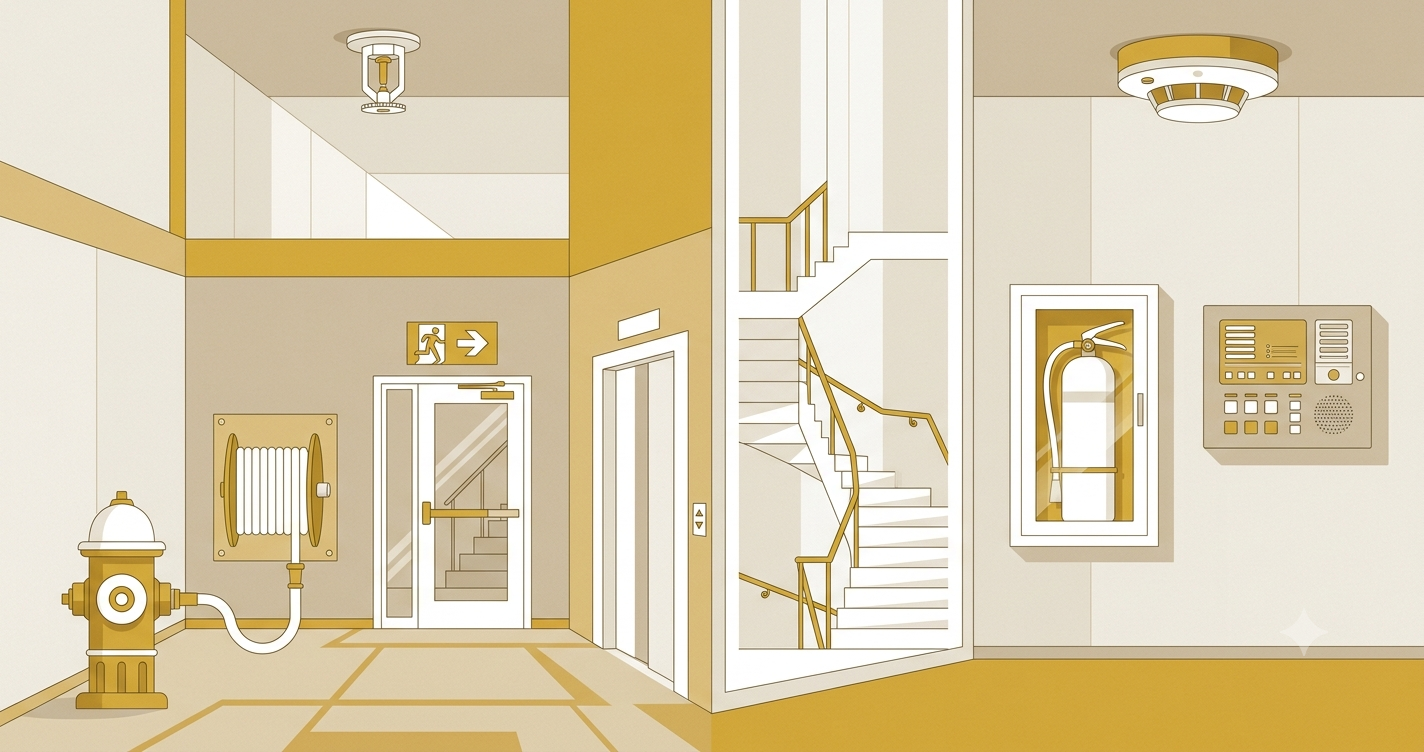
Passive fire protection (PFP) encompasses all structural and architectural elements that contain fire and slow its spread without any active operation — unlike sprinklers and alarms which actively intervene. It includes: fire-rated walls and floors, fire-rated doors, thermal protection for structural steelwork, and penetration sealing materials.
Fire Compartmentation Principles
Compartmentation divides a building into independent fire-compartments that contain a fire within them for a defined period per the UAE Civil Defence Code:
Maximum Compartment Areas — UAE Code
| Occupancy Type | Max Area (without sprinklers) | Max Area (with sprinklers) |
|---|---|---|
| Commercial Offices | 2,000 m² | 4,000 m² |
| General Warehouses | 1,500 m² | 3,000 m² |
| Factories & Industrial Facilities | 2,000 m² | 4,000 m² |
| Hospitals & Healthcare | 400 m² | 800 m² |
| Hotels & Residential Towers | 500 m² | 1,000 m² |
| Retail Premises | 1,000 m² | 2,000 m² |
Important Note: For high-piled racking storage (HPLS), compartment areas may be further reduced based on a Fire Risk Assessment (FRA) approved by ADCDA.
Fire Resistance Classifications for Structural Elements
Fire resistance performance is classified by three criteria per BS EN 13501:
- R — Load-bearing Capacity: Duration the element maintains its structural load-bearing function
- E — Integrity: Duration of prevention of flames and hot gases passing through
- I — Insulation: Duration of prevention of the unexposed face exceeding 140°C average temperature rise
Typical UAE Wall Requirements
- REI 60: Separating wall between office areas and service areas
- REI 120: Compartment walls between warehouses and factories
- REI 240: Firewalls in high-risk industrial applications
Fire-Rated Doors — Classifications & Requirements
Door Classifications
| Classification | Fire Resistance Duration | UAE Code Applications |
|---|---|---|
| FD30 / E30 | 30 minutes | Internal office doors, corridors leading to stairs |
| FD60 / EI 60 | 60 minutes | Warehouses, main stairwells, compartment-to-corridor doors |
| FD90 / EI 90 | 90 minutes | High-hazard area entrances, hospitals |
| FD120 / EI 120 | 120 minutes | Major firewalls, heavy industrial applications |
Fire Door Installation Requirements — UAE Code
- Self-Closing Device: Mandatory — overhead door closer or floor spring
- Gap Under Door: Maximum 10 mm normally, maximum 3 mm with smoke seals fitted
- Gap Around Frame: Maximum 3 mm on all sides
- Smoke Seals: Mandatory on all doors leading to escape routes
- Hold-Open Devices: Permitted only when linked to the fire alarm system and self-closing on alarm
- Glazing: Must be fire-rated glass; maximum 25% of door leaf area for FD30
- Locks: Must open from the inside without a key in the direction of escape
Intumescent Protection for Structural Steelwork
Steel loses 60% of its strength at 550°C — in a typical fire, this temperature is reached within 5–8 minutes. Thermal protection is a structural necessity:
Intumescent Paint
- Operating Principle: Expands on exposure to heat, forming an insulating foam char layer that delays heat transfer to the steel
- Applied Thickness: 0.5 mm to 8 mm depending on required fire rating and steel section factor
- Protection Ratings: R30 · R60 · R90 · R120
- Application: Shop-applied or on-site; requires minimum SSPC-SP6 surface preparation
Protective Boards
- Promat, vermiculite or reinforced gypsum boards encasing columns and beams
- Suited for large columns and beams in warehouses and factories
- Achieves up to R240 — the highest commercially available rating
Penetration Sealing — Firestopping
One of the most frequently overlooked aspects of PFP — any unprotected penetration through a fire-rated wall completely nullifies its resistance:
Approved Firestop Products
- Firestop Sealant: For small gaps around cables and pipes — Hilti CFS-SIL or 3M CP 25WB+
- Firestop Foam: For large voids around service penetrations — Hilti CP 620
- Intumescent Collar: Mounted around plastic pipes; compresses the pipe on fire activation preventing spread — Promat or equivalent
- Intumescent Pillows: Filled into large cable openings; removable for future cable additions
Application Requirements
- The UAE Code requires sealing of all penetrations through fire-rated walls and floors
- Products must be tested and listed to the same rating as the element being penetrated
- All firestop installations documented in approved As-Built drawings
- Annual inspection of all penetration seals during preventive maintenance rounds
Practical Examples
5,000 m² Warehouse Without Sprinklers: Must be divided into at least 4 compartments with REI 120 walls, with FD60 doors at each interconnecting corridor. Estimated fire doors required: 8–12 doors.
3-Storey Office Building: Each floor is an independent compartment with REI 60 floor/ceiling assembly between levels. All cable and pipe penetrations between floors sealed with certified firestop products. FD30 doors on all staircase entrances.
Steel Column Supporting 2 Floors (R60 required): Intumescent paint thickness approximately 1.5–2.5 mm (varies by paint supplier and section factor).
Integration of PFP with Active Systems
- Fire Doors + Alarm: Hold-open doors close automatically via electromagnetic release on alarm
- Fire Walls + Sprinklers: Sprinklers in each compartment independently — sprinklers do not eliminate the wall requirement but enable larger compartment areas
- HVAC Penetrations + Dampers: Fire dampers required at every ductwork penetration through a fire-rated wall