Components of an Emergency Evacuation System
The emergency evacuation system comprises three interconnected elements per the UAE Civil Defence Code:
- Escape Route Lighting: Illumination of corridors, exits and stairwells to enable safe evacuation
- Open Area (Anti-Panic) Lighting: Illumination of large open spaces such as halls and warehouses to prevent panic
- Illuminated Exit Signs: Self-illuminated signs directing building occupants to the nearest exit
Escape Route Lighting Requirements — BS EN 1838 & UAE Code
Minimum Illuminance Levels
- Escape Routes (corridors, stairwells): Minimum 1 lux at the centre of the escape route at floor level
- Open Areas (Anti-Panic): Minimum 0.5 lux at any point on the clear floor area
- High-Risk Task Areas: Minimum 10% of the normal illuminance level or 15 lux, whichever is greater
- Uniformity Ratio: Maximum 40:1 between highest and lowest illuminance values on the escape route
Switchover Time
- Escape Routes & Anti-Panic Areas: 50% of required illuminance within 5 seconds; 100% within 60 seconds
- High-Risk Task Areas: 100% illuminance within 0.5 seconds (half a second)
Battery Duration
- UAE Code & GCC Code: Minimum 3 full hours in emergency mode
- Hospitals & Care Facilities: Minimum 3 hours with an additional backup generator requirement
- After Rated Duration: System must continue to operate for a minimum of 5 additional seconds without falling below 50% of required illuminance
Emergency Luminaire Types
- Maintained: Lit continuously under normal conditions and remains lit in emergency — ideal for stairwells and continuous corridors
- Non-Maintained: Only illuminates on power failure — suitable for areas well-lit under normal fire conditions
- Central Battery System: Central batteries power all emergency luminaires throughout the building — preferred for towers and large facilities
- Self-Contained: Each unit has its own battery — easy to install and maintain in small to medium facilities
Illuminated Exit Signs — Detailed Requirements
Positioning & Distribution
- At every exit: An illuminated sign above or immediately adjacent to every exit door
- At every change of direction: Directional sign at every turn in the escape route
- Where direction is unclear: At any point where an occupant might doubt the correct direction
- Long corridors: Maximum 30 m between consecutive signs in a straight corridor (for 100 mm legend height)
- Mounting height: Bottom edge of sign at 2.0–2.5 m from floor level
Maximum Viewing Distances
| Legend / Symbol Height | Maximum Viewing Distance |
|---|---|
| 100 mm (small signs) | 30 m |
| 150 mm | 45 m |
| 200 mm | 60 m |
| 150 mm pictogram | 24 m (ISO 7010) |
Illumination & Symbol Requirements
- Internal Illumination: Minimum 10 lux on the sign face surface
- Photoluminescent Signs: Accepted only where ambient illuminance is not less than 1 lux for at least 60 minutes before the emergency
- Approved Symbol: Green running man per ISO 7010 E001 — the only approved symbol in the UAE
- Colour: Green background with white symbol (or white on green) — red or yellow colours are not permitted for exit signs
Positioning Requirements for the Complete System
Stairwells & Exits
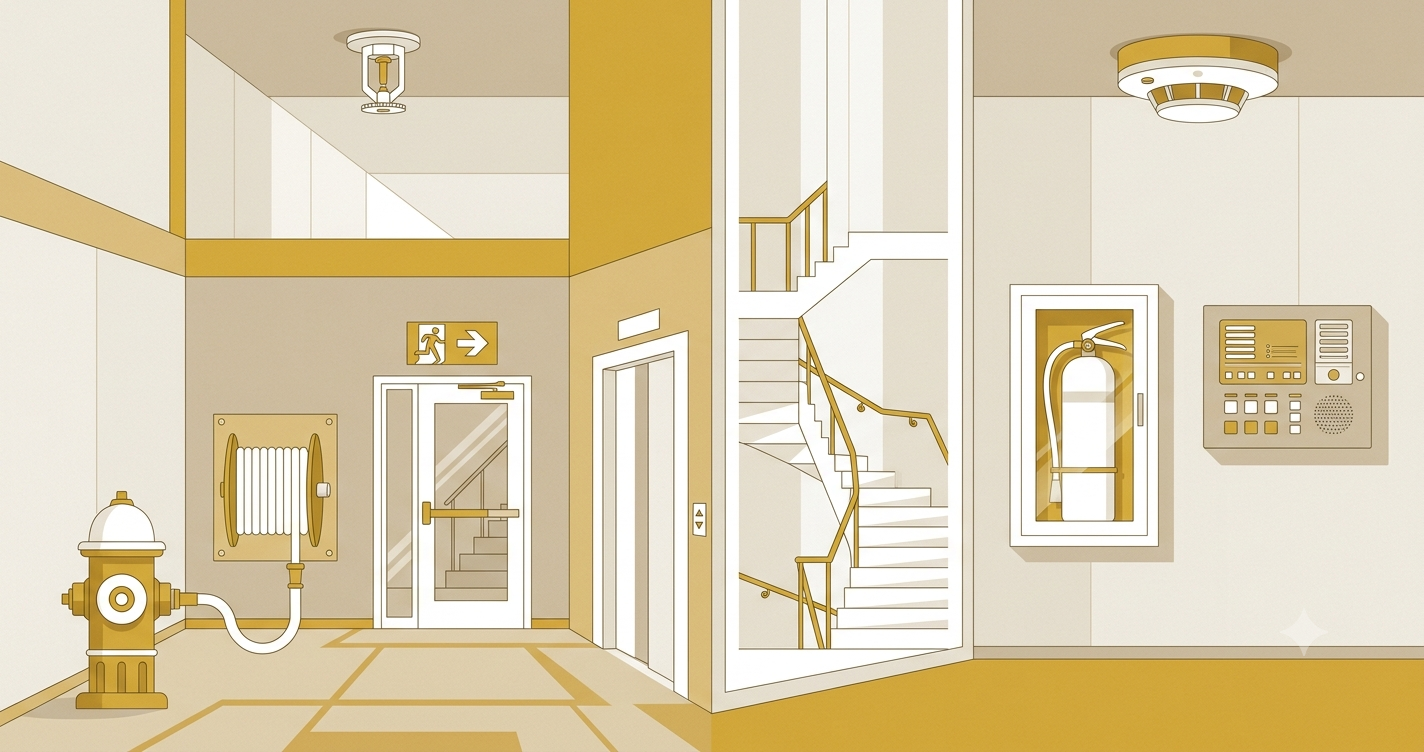
- One emergency luminaire at each end of every stair flight (landing)
- One luminaire at every change of direction in stairwells
- A light source on every landing and above every turn
- Exit sign above every door leading to the exterior or to a protected stairwell
Corridors & Lobbies
- Every corridor intersection: directional sign
- Long straight corridor: emergency luminaire every 12 m maximum
- Adjacent to all firefighting equipment (extinguishers, hose reels)
- At the main alarm panel and emergency communication device
Car Parks & Large Assembly Areas
- Large open areas (halls, warehouses): one anti-panic luminaire per 50–60 m² (to achieve 0.5 lux at every point)
- No point in an open area to be more than 10 m from an illuminated exit sign
Practical Examples
Commercial Office 400 m² (Single Floor): Two main corridors, each 20 m × 3 m:
Emergency lighting: 2 units per corridor (every 10 m) + 1 at each exit = 6 luminaires. Exit signs: 2 exits × 1 sign = 2 signs. Total: 6 luminaires + 2 exit signs.
Warehouse 2,000 m² (8 m ceiling): Large open area:
Anti-Panic: 2,000 ÷ 55 ≈ 37 emergency luminaires distributed to achieve 0.5 lux everywhere. Exit signs: 4 exits × 1 sign = 4 signs + internal directional signs ≈ 6–8 additional signs.
10-Storey Hotel with 4 Protected Stairwells: Each stair: 10 landings × 2 luminaires = 20 units. 4 stairs = 80 stairwell luminaires alone. Add exit signs at every stair entrance and every external door.
Inspection & Maintenance — UAE Code Requirements
- Monthly Test: Functional test of minimum 1 minute duration for each unit — verifies response to power failure
- Full Annual Test: Run all emergency luminaires for the full rated duration (3 hours) — verifies battery condition
- Inspection Log: Every test documented in an approved register submitted to civil defence on request
- Battery Replacement: Maximum every 4 years per manufacturer recommendations
- Illuminance Testing: Annual lux meter measurement to verify levels meet the required standards
System Integration
- Emergency Lighting + Alarm: All emergency luminaires activate automatically on alarm trigger
- Exit Signs + Emergency Doors: Signs aligned with actual exit door positions without exception
- Emergency Doors + Alarm: Magnetically held doors (Mag-Held) release automatically on alarm
- Public Address (PA) System: Voice evacuation instructions operating in parallel with lighting and signs
- Lifts: Automatic recall to ground floor and door closure on alarm