Short answer
In Abu Dhabi, safety signs fall under ADOSH-SF CoP 17.0 (version 4.0): red for prohibition and danger, yellow or amber for warning, blue for mandatory, and green for emergency escape, first aid and no danger (clause 3.6, Table 2). Signs must be large and clear enough to be seen, in a language suited to the workforce including Arabic and English, durable, securely fastened and maintained, and permanent unless the hazard is temporary (clause 3.4). In Dubai the construction safety code adds the majority language of the workforce, a symbol with every text, rounded corners and a minimum letter height for each viewing distance (clause 6.2, Tables 1 and 2). Neither code sets a sign size. The framework is administered by ADPHC (ADOSH-SF, formerly OSHAD-SF), which does not approve particular signs or products.
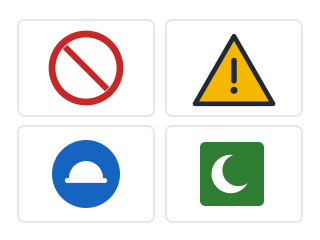
 Red: prohibition and danger
 Yellow or amber: warning
 Blue: mandatory
 Green: emergency escape, first aid, no danger
What the code requires
| Requirement | Source clause |
|---|---|
| Colours: red for prohibition and danger; yellow or amber for warning; blue for mandatory; green for emergency escape, first aid and no danger | Abu Dhabi: ADOSH-SF CoP 17.0 clause 3.6, Table 2 |
| Signs large and clear enough to be seen | CoP 17.0 clause 3.4(e) |
| A language suited to the workforce, including Arabic and English | CoP 17.0 clause 3.4(f) |
| Durable, securely fastened and maintained | CoP 17.0 clause 3.4(g) |
| Permanent unless the workplace or hazard is temporary | CoP 17.0 clause 3.4(h) |
| Dubai: Arabic, English and the majority language; symbol plus text; rounded corners | Dubai Municipality construction safety code, clause 6.2 |
| Dubai: prohibition black on white in a red crossed circle; warning black on yellow in a black triangle; mandatory white on a blue circle; information white on green | Dubai Municipality code, clause 6.4, Table 2 |
| Dubai: minimum letter height for each viewing distance, from 0.64 cm at 3 m to 12.5 cm at 60-75 m | Dubai Municipality code, clause 6.2(9), Table 1 |
| Sign size (either emirate), material, fixing method | Not specified in the sources used here |
Selected minimum letter heights from Dubai Table 1:
| Viewing distance | Minimum letter height |
|---|---|
| Up to 3 m | 0.64 cm |
| 3 - 6 m | 1.25 cm |
| 6 - 9 m | 1.9 cm |
| 9 - 12 m | 2.5 cm |
| 12 - 18 m | 3.8 cm |
| 18 - 23 m | 5 cm |
| 36 - 45 m | 10 cm |
| 60 - 75 m | 12.5 cm |
The table shows only the rows available in the source used; read the full Dubai table in the code itself. If you are looking at bilingual safety signs made to the CoP 17.0 colour and size rules, note that CoP 17.0 fixes colours, language and durability but no dimension: size follows from the requirement that the sign can be seen, and in Dubai from the letter heights.
Scope note: the colour, language and durability rules in CoP 17.0 are Abu Dhabi rules; the majority language, symbol-plus-text, rounded corners and the letter-height table are Dubai rules. The source used here also states that ISO 7010 symbols are the set both codes refer to; check each code's text for that reference.
Beyond safety signs, see also the full set of signs a UAE site carries, which includes entrance and traffic signs.
Who is responsible
The sources used here do not name a party responsible for selecting, installing or maintaining safety signs. Clause 3.4 sets out the properties a sign must have (visibility, language, durability, upkeep), not who provides it. Confirm the responsible party against the permit conditions, the project safety plan and the contractor's contract.
What an inspection against these clauses looks at
- The colour and shape of each sign against its function: prohibition, warning, mandatory, safe condition (CoP 17.0 clause 3.6, Table 2; Dubai Table 2).
- Whether the sign is large and clear enough to be seen from where it stands (CoP 17.0 clause 3.4(e)).
- Language: Arabic, English and a language suited to the workforce; in Dubai the majority language too (clauses 3.4 and 6.2).
- In Dubai: a symbol with every text, and rounded corners (clause 6.2).
- In Dubai: whether the letter height meets the minimum for the viewing distance (Table 1).
- The condition of the sign: durable, securely fastened, maintained (3.4(g)).
- Whether the sign is permanent, and where it is temporary, whether the hazard or workplace really is (3.4(h)).
Typical gaps against the requirement
- A colour that does not match the sign's function, such as a warning that is not yellow or amber (CoP 17.0 Table 2).
- English-only text (clause 3.4(f); in Dubai clause 6.2).
- Text with no symbol in Dubai (clause 6.2).
- Letters smaller than the Dubai minimum for the distance they are read from (Table 1).
- A faded or loosely fixed sign (clause 3.4(g)).
- A temporary sign used for a permanent hazard (clause 3.4(h)).
- Treating a size common on the market as a regulatory requirement when neither code sets one (not specified).
Checklist
- ☐ Sign colours match function: red prohibition, yellow or amber warning, blue mandatory, green safe condition (17.0 Table 2)
- ☐ Signs large and clear enough to be seen from where they stand (17.0 clause 3.4(e))
- ☐ Text in Arabic, English and a language suited to the workforce (3.4(f))
- ☐ Dubai: majority language present on the signs (6.2)
- ☐ Dubai: a symbol accompanies every text (6.2)
- ☐ Dubai: sign corners are rounded (6.2)
- ☐ Dubai: shape and colour pairings follow Table 2 (6.4)
- ☐ Dubai: letter height meets the minimum for the viewing distance (Table 1)
- ☐ Signs durable, securely fastened and maintained (3.4(g))
- ☐ Signs permanent except where the hazard is temporary (3.4(h))
- ☐ Responsible party identified from permit and contract
Temporary notices are a separate matter; see site banners and temporary notices, bearing in mind that CoP 17.0 asks for permanent signboards unless the hazard is temporary.
FAQ
What colours do safety signs use in the UAE?
Red for prohibition and danger, yellow or amber for warning, blue for mandatory, and green for escape, first aid and no danger, per CoP 17.0 clause 3.6, Table 2 in Abu Dhabi. Dubai sets shapes and colours in clause 6.4, Table 2 of its construction safety code.
Do safety signs need to be in Arabic?
Yes. CoP 17.0 asks for a language suited to the workforce including Arabic and English, and the Dubai code requires Arabic, English and the majority language, with a symbol for every text.
How big does a safety sign have to be?
Neither code sets a sign size. Abu Dhabi requires the sign to be large and clear enough to be seen. In Dubai, Table 1 sets minimum letter heights by distance, for example 2.5 cm for 9-12 m and 5 cm for 18-23 m.
Can temporary signs be used?
CoP 17.0 asks for permanent signboards unless the workplace or hazard is temporary. The same colours and rules apply to temporary signs.
Does ADPHC approve safety signs or suppliers?
No. ADPHC administers the ADOSH-SF framework and does not approve particular signs or suppliers. What is checked is whether the sign meets the colour, language and durability clauses.
Looking for a supplier for these signs — or want to have them printed?
Art for Printing is our trusted printing and signage partner in the UAE for site signage: it produces prohibition, warning, mandatory and safe-condition signs for construction sites.
Disclosure: Art for Printing is independent of SafePass. SafePass has a marketing agreement with it to direct readers who need printing. This is a commercial referral, not an approval or certification by ADPHC or any authority, and the requirements above apply whichever supplier you use.