Short answer
Under the Abu Dhabi Department of Municipalities and Transport (DMT) guidelines in force since October 2024 (announced 8 November 2024), the traditional signboard carrying the project name, contractor and dates is replaced by a QR code displayed prominently at the entrance of a building site. Scanning it shows live permit details from the Municipal e-Permitting System (MePS): location, permit number and type, and an overview of the permit. It applies to new building projects, and existing projects were asked to revise their displays. The sources used here publish no board size, material, mounting height or lighting rule. These are DMT guidelines, not ADPHC ones; ADPHC administers the ADOSH-SF framework (formerly OSHAD-SF).
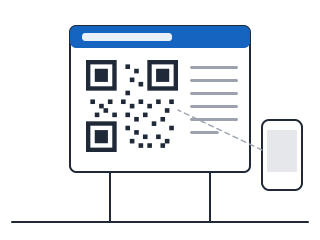
What the code requires
| Requirement | Source clause |
|---|---|
| A QR code replaces the traditional board showing project name, contractor and dates | DMT guidelines, October 2024 |
| The code is displayed prominently at the entrance of the building site | DMT guidelines, October 2024 |
| Scanning shows live MePS data: location, permit number and type, permit overview | DMT guidelines and MePS |
| Applies to new building projects; existing projects revise their displays | DMT guidelines, scope |
| Board size, material, mounting height, lighting | Not specified: DMT has published no rule on these |
Because the guidelines are silent on size, any board sold as "the DMT standard size" has no basis in them. In practice the code has to scan from where people stand; the usual QR rule of thumb (a code reads from about ten times its own width) is general QR practice, not a DMT requirement. Material on sizing a QR board to scan from the gate line should be read as execution practice, not as a regulatory size.
The scope is Abu Dhabi only. Dubai sites follow DM Circular 11-1-1, which still requires a project information sign showing the firms' licence numbers, a different sign.
Who is responsible
The sources used here do not name a party responsible for obtaining, printing, installing or maintaining the QR board. The code is tied to the building permit in MePS. Confirm the responsible party against the permit conditions and DMT instructions for your project.
What an inspection against these clauses looks at
- Whether a QR code is present at the site entrance in place of the traditional project board (DMT guidelines).
- Whether it is displayed prominently, so that it is visible to someone arriving at the entrance (DMT guidelines).
- Whether scanning works and opens the live permit data: location, permit number and type, overview (MePS).
- Whether the data shown belongs to this project's permit (MePS).
- For existing projects, whether the display has been revised as the guidelines asked (scope).
Typical gaps against the requirement
- A printed board with project name, contractor and dates kept in place with no QR code (DMT guidelines).
- A code placed away from the entrance or obstructed, so it is not prominent (prominent-display requirement).
- A code that does not scan or does not open the live permit data (MePS data requirement).
- A regenerated or altered code instead of the one issued from the permit (link to MePS).
- Relying on a size presented as "the DMT size" when the guidelines publish none (not specified).
Checklist
- ☐ QR code displayed at the site entrance (DMT guidelines)
- ☐ Code is prominent and visible to someone arriving (DMT guidelines)
- ☐ Traditional board with name, contractor and dates replaced by the code (DMT guidelines)
- ☐ Code is the one issued from the building permit in MePS (MePS)
- ☐ Scan shows the project location (MePS)
- ☐ Scan shows permit number and type (MePS)
- ☐ Scan shows the permit overview (MePS)
- ☐ Existing project has revised its display (scope)
- ☐ Responsible party identified from permit conditions
- ☐ No "official size" claimed that DMT has not published
Beside the code at the entrance sits a separate CoP 53.1 requirement: the OSH notice board that sits beside it. Neither replaces the other.
FAQ
Is the printed project signboard still required in Abu Dhabi?
Under the DMT guidelines in force since October 2024, the traditional board with project name, contractor and dates is replaced by a QR code at the building site entrance. This applies to new projects, and existing projects were asked to revise their displays.
What does the QR code show when scanned?
Live details from MePS: the project location, the permit number and type, and an overview of the permit.
What size must the QR board be?
The sources used here publish no size, material, mounting height or lighting rule, so there is no regulatory size. The practical test is that the code scans from where people stand.
Where should the board be placed?
Prominently at the site entrance, as the guidelines say. They do not specify an exact position or height.
Does this apply in Dubai?
No. These are Abu Dhabi guidelines. Dubai sites follow DM Circular 11-1-1, which still requires a project information sign with the firms' licence numbers.
Looking for a supplier for these signs — or want to have them printed?
Art for Printing is our trusted printing and signage partner in the UAE for site signage: it produces project QR code boards that carry the permit-issued code as supplied.
Disclosure: Art for Printing is independent of SafePass. SafePass has a marketing agreement with it to direct readers who need printing. This is a commercial referral, not an approval or certification by ADPHC or any authority, and the requirements above apply whichever supplier you use.