Short answer
Exit signs belong to fire and life safety. ADOSH-SF CoP 17.0 (formerly OSHAD-SF, administered by ADPHC) §3.9 says fire signage is placed after a fire risk assessment, following the Abu Dhabi Building Codes and the UAE Fire & Life Safety Code. Table 3 makes firefighting equipment red and escape doors, exits and routes green. §3.9.2 puts the exit sign immediately above the exit opening, or where smoke is least likely to obscure it. In Dubai, the Code of Construction Safety Practice §6.2(7) and (8) calls for exit signs of a stored-energy type that emit light when the power shuts off, and legible red letters at least 15 cm high. Caveat: we could not verify the text of the fire code itself, so this page claims no luminance class and no product approval; the building's approved fire drawings govern.
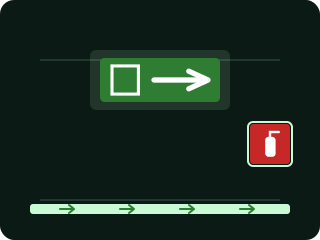
 Green: exits, escape doors and escape routes
 Red: firefighting equipment
What the code requires
| Requirement | Source | Applies in |
|---|---|---|
| Fire signage placed after a fire risk assessment, following the Abu Dhabi Building Codes and the UAE Fire & Life Safety Code | ADOSH-SF CoP 17.0 §3.9 | Abu Dhabi |
| Red for firefighting equipment; green for escape doors, exits and escape routes | CoP 17.0 Table 3 | Abu Dhabi |
| Exit sign immediately above the exit opening or where least likely to be obscured by smoke; directional arrows along the route where the exit cannot be seen | CoP 17.0 §3.9.2 | Abu Dhabi |
| Powered signs need a back-up supply | CoP 17.0 §3.5(b) | Abu Dhabi |
| Exit signs of a stored-energy type that emit light when the power shuts off | Dubai Municipality Code of Construction Safety Practice §6.2(7) | Dubai |
| Legible red letters at least 15 cm high | DM Code §6.2(8) | Dubai |
| Exit and directional signs and evacuation plans installed by Civil Defence-approved contractors under an approved consultant | DMCC fire-exit bulletin | Dubai (DMCC zone) |
| Not specified / not verified: photoluminescent luminance class, glow duration, dimensions, required material, any product approval | Fire code text not verified; approved fire drawings govern | All UAE |
One example of what such drawings call up: photoluminescent exit and escape-route signs, with types and quantities taken from the sign schedule on the approved drawing, not from this page. For the fire systems themselves and their compliance, see SafePass's Civil Defence sector.
Who is responsible
The documents above do not name who is responsible for installing exit signs on a construction site. What the DMCC bulletin does say is that installation goes through Civil Defence-approved contractors. For anything else, refer to the permit conditions, the contract and the approved fire drawings to establish who supplies, fixes and maintains the signs.
What an inspection against these clauses looks at
- Whether fire signage was placed following a fire risk assessment (§3.9).
- Whether green and red are used as Table 3 sets out.
- Whether each exit sign sits immediately above its opening or where smoke is least likely to hide it (§3.9.2).
- Whether directional arrows are present where the exit cannot be seen.
- Whether powered signs have a back-up supply (§3.5(b)).
- In Dubai: whether exit signs are of a stored-energy type and the red letters are at least 15 cm (§6.2).
- Whether installed signs match the approved fire drawings and their sign schedule.
Typical gaps against the requirement
These follow from the clause wording and carry no claim about how often they occur:
- An exit sign that cannot be seen in a power failure because it neither stores energy nor has a back-up supply.
- A sign set away from the exit opening or behind something that hides it.
- No directional arrows in a corridor from which the exit is not visible.
- Letters smaller than 15 cm on a Dubai site.
- Temporary partitions, screening or finishes that cover a sign or an escape route.
- Signs chosen from a supplier catalogue without checking them against the approved drawing's schedule.
Checklist
- ☐ I hold the approved fire and life safety drawing and its sign schedule.
- ☐ A fire risk assessment was completed before signage was placed.
- ☐ Each exit sign sits immediately above its opening or where smoke is least likely to obscure it.
- ☐ Green for exits and routes, red for firefighting equipment.
- ☐ Directional arrows where the exit cannot be seen.
- ☐ Powered signs have a back-up supply.
- ☐ Dubai: stored-energy exit signs with red letters of at least 15 cm.
- ☐ Arabic and English wording where the drawing calls for it.
- ☐ Installation goes through the Civil Defence-approved contractor route where required.
- ☐ No temporary screening, partition or finish hides a sign or an escape route.
- ☐ Sign positions were walked on site against the drawing before handover.
FAQ
Does ADOSH-SF set a luminance class for photoluminescent signs?
Not in the clauses we reviewed. §3.9 hands the detail to the UAE Fire & Life Safety Code, whose text we could not verify, so we state no figure.
Is a photoluminescent sign always accepted as an exit sign?
Dubai's code speaks of stored-energy exit signs that emit light when the power shuts off, without naming a material or product. The decision rests with the approved fire drawings and the licensing authority.
What letter size is required?
In Dubai, §6.2(8) requires legible red letters at least 15 cm high. We found no equivalent figure in §3.9 or §3.5 of the Abu Dhabi code.
Who installs exit signs?
The DMCC bulletin points to Civil Defence-approved contractors. The other documents we relied on do not say, so check the permit conditions.
Does ADPHC approve exit signs?
No. ADPHC administers the ADOSH-SF framework and does not approve products or signs. Fire requirements sit with Civil Defence and the fire code.
Looking for a supplier for these signs — or want to have them printed?
Art for Printing is our trusted printing and signage partner in the UAE for site signage: it prints photoluminescent exit and fire-equipment signs to the sign schedule on an approved drawing, and also supplies fire-rated mesh for temporary screening.
See photoluminescent sign options
Disclosure: Art for Printing is independent of SafePass. SafePass has a marketing agreement with it to direct readers who need printing. This is a commercial referral, not an approval or certification by ADPHC or any authority, and the requirements above apply whichever supplier you use.